YUKI KONDO
Behavioral & Reproductive
Ecology of Wild Medaka
Linking laboratory experiments and muddy field observations to uncover the reproductive ecology of Oryzias latipes.
ABOUT
Yuki Kondo, Ph.D.
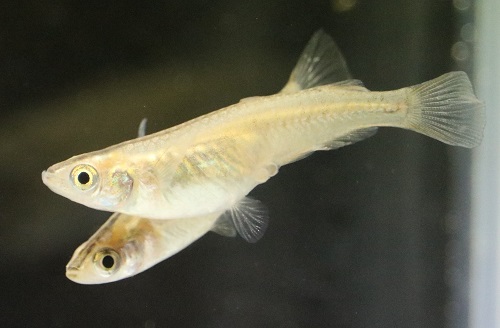
I am a behavioral ecologist working on the reproductive ecology of medaka fish (Oryzias latipes). My research combines aquarium-based experiments with field observations in Gifu, Japan, asking whether patterns discovered in the laboratory actually hold under natural conditions. Recent work has revealed that wild medaka begin courtship and spawning around midnight — overturning the long-held belief that they reproduce only at dawn — and that males flexibly adjust sperm allocation according to female quality, rival presence, and previous mating history.
Position: Specially Appointed Assistant Professor
Affiliation: Department of Biology, Graduate School of Science, Osaka Metropolitan University
Address: 3-3-138 Sugimoto, Sumiyoshi-ku, Osaka 558-8585, Japan
Email: youkikondou[at]omu.ac.jp · youkikondou[at]gmail.com
(Replace [at] with @)
ORCID 0000-0002-1481-6225 · Google Scholar · researchmap · X (@diary_of_yuki)
RESEARCH INTERESTS
From behavior and reproduction to society
Keywords: Sperm allocation · Mate choice · Sexual conflict · Alternative reproductive tactics · Field ethology
My core question is how males and females resolve evolutionary conflicts over reproduction, and how these mechanisms scale up to social structure in fish. I use 24-hour video monitoring, automated pose tracking, and night-time field surveys to bridge the gap between controlled laboratory experiments and the messy reality of wild populations.
Three thematic lines currently run in parallel:
- Sperm economics — how males allocate a finite ejaculate across mating opportunities, and how females respond.
- Field-based reproductive ecology — when and where wild medaka actually spawn, often at odds with classical laboratory accounts.
- Complex social relationships — individual recognition, shoaling, and territoriality (ongoing JSPS Early-Career project, 2025–2028).
SELECTED PUBLICATIONS
First-author papers
- Kondo Y, Ito T, Awata S. Qualitative sperm depletion: successive mating reduces initial sperm velocity in medaka fish. Journal of Ethology. 2026 Apr; 44(3): 221–229. Peer-reviewed · Corresponding author
- Kondo Y, Kobayashi R, Kobayashi Y, Koya Y, Awata S. Temporal shifts in ovulation between laboratory and semi-natural environments in the model fish medaka. Royal Society Open Science. 2026 Mar; 13(3): 251946. Peer-reviewed · Corresponding author
- Kondo Y, Kobayashi R, Kobayashi Y, Awata S. Temporal dynamics of courtship and spawning in medaka under laboratory conditions revealed by 24 h video monitoring. Scientific Reports. 2025 Aug; 15(1): 26576. Peer-reviewed · Corresponding author
- Kondo Y, Awata S. Courtship and spawning behaviour of medaka in a semi-outdoor environment initiating at midnight. Scientific Reports. 2025 May; 15(1): 17057. Peer-reviewed · Corresponding author
- Kondo Y, Okamoto K, Kitamukai Y, Koya Y, Awata S. Medaka (Oryzias latipes) initiate courtship and spawning late at night: insights from field observations. PLOS ONE. 2025 Feb; 20(2): e0318358. Peer-reviewed · Corresponding author
- Kondo Y, Kohda M, Awata S. Male medaka continue to mate with females despite sperm depletion. Royal Society Open Science. 2025 Jan; 12(1): 241668. Peer-reviewed · Corresponding author
- Kondo Y, Kohda M, Koya Y, Awata S. Sperm allocation in relation to male-male aggression and courtship in an externally fertilizing fish, the medaka. Animal Behaviour. 2023 Aug; 202: 9–19. Peer-reviewed · Corresponding author
- Kondo Y, Kohda M, Koya Y, Awata S. Sperm allocation strategies depending on female quality in medaka (Oryzias latipes). Zoological Science. 2020 May; 37(3): 203–209. Peer-reviewed · Corresponding author
AWARDS
Honors
- 2025 — Research Award, Kinki Regional Conference, Ecological Society of Japan
- 2025 — Excellent Poster Award, 44th Annual Meeting of the Japan Ethological Society
- 2022 — Best Poster Award, 69th Annual Meeting of the Ecological Society of Japan
- 2020 — Best Poster Award, 39th Annual Meeting of the Japan Ethological Society
FUNDING
Active and past grants
- 2025–2028 — JSPS Grant-in-Aid for Early-Career Scientists (PI) — Formation processes of complex social relationships in animals using medaka as a model
- 2024–2027 — JSPS Grant-in-Aid for Scientific Research (C) (Co-investigator) — Chemical communication in medaka mating behaviour
- 2022–2025 — JSPS Grant-in-Aid for Research Activity Start-up (PI) — Sperm allocation strategies
- 2023, 2024 — Sasakawa Scientific Research Grant (PI)
- 2024, 2025, 2026 — Kurita Water and Environment Foundation Research Grant (PI)
EDUCATION & CAREER
CV timeline
- 2026.05 – present
- Specially Appointed Assistant Professor, Department of Biology, Graduate School of Science, Osaka Metropolitan University
- 2026.04
- Research Fellow, Department of Biology, Graduate School of Science, Osaka Metropolitan University
- 2022.04 – 2026.03
- Specially Appointed Assistant Professor, Department of Biology, Graduate School of Science, Osaka Metropolitan University
- 2022.03
- Ph.D. in Science, Department of Biology and Geosciences, Graduate School of Science, Osaka City University
- 2018.04 – 2022.03
- Doctoral Program, Graduate School of Science, Osaka City University
- 2018.03
- M.S. in Education, Graduate School of Education, Gifu University
- 2016.04 – 2018.03
- Master’s Program, Graduate School of Education, Gifu University
- 2016.03
- B.S. in Education (School Teacher Training Course), Faculty of Education, Gifu University
Professional societies: Ecological Society of Japan · Japan Ethological Society · Ichthyological Society of Japan · International Society for Behavioral Ecology
Field experience: Yakushima Macaque Survey, NPO Yakushima Wildlife Conservancy (2012–2022) — long-term primate field censuses that shaped my field-oriented research style.
GET IN TOUCH
Open to collaboration
I welcome inquiries about collaborations, invited talks, and interviews. The fastest response is by email.
Email: youkikondou[at]omu.ac.jp · youkikondou[at]gmail.com
(Replace [at] with @)
Postal address: Department of Biology, Graduate School of Science, Osaka Metropolitan University, 3-3-138 Sugimoto, Sumiyoshi-ku, Osaka 558-8585, Japan
ORCID · Google Scholar · researchmap · X