日本語 |
English
A behavioral ecologist chasing the “midnight spawning” of wild medaka.
I combine 24-hour video monitoring with old-fashioned field surveys to uncover how medaka actually breed in the wild.
About this site
This is the personal website of Yuki Kondo, a behavioral ecologist studying the reproductive biology of wild medaka (Oryzias latipes) at Osaka Metropolitan University.
The site is primarily aimed at fellow researchers and prospective collaborators. It contains a short research overview, a list of selected publications, a record of funding and awards, and recent updates. A more extensive Japanese version of the site — including outreach materials for teachers and students, and personal notes — is available at youkikondou.com.
Recent updates
May 2026 — Appointed Specially-Appointed Assistant Professor at the Graduate School of Science, Osaka Metropolitan University.
April 2026 — New first-author paper published. In medaka, males that mated repeatedly within a few hours showed an approximately 20% reduction in the initial swimming velocity of sperm remaining in their testes, compared with males that mated only once. [Link]
April 2026 — Joined the Laboratory of Animal Sociology, Osaka Metropolitan University, as a JSPS Research Fellow.
March 2026 — Japanese press release of our previous paper was issued. [Link]
Profile
Name: Yuki Kondo (近藤 湧生, Kondo Yuki)






Affiliation: Department of Biology, Graduate School of Science, Osaka Metropolitan University
Position: Specially-Appointed Assistant Professor
Address: 3-3-138 Sugimoto, Sumiyoshi-ku, Osaka 558-8585, Japan
Email:
Mail 1: youkikondou[at]gmail.com
Mail 2: youkikondou[at]omu.ac.jp
([at] → @; clicking will open your mail client)
Research areas: Behavioral ecology, reproductive ecology, sexual selection
Memberships:
- The Ichthyological Society of Japan (2016–) [Link]
- Japan Ethological Society (2017–) [Link]
- Ecological Society of Japan (2017–) [Link]
- International Society for Behavioral Ecology (2022–) [Link]
A short bio
Observing medaka courtship behavior
I am broadly interested in how organisms make a living — how they reproduce, communicate, and maintain whatever counts as a society in their world. The questions I keep coming back to are: who mates with whom and when, how do animals communicate without voice or language, and how stable are the social relationships that emerge in seemingly anonymous groups?
My current focus is the southern medaka (Oryzias latipes). Medaka has long served as a model organism in developmental biology, genetics, toxicology, and evolutionary biology, yet its behavioral and reproductive ecology in the wild is surprisingly under-explored. I combine aquarium experiments, semi-outdoor and outdoor observations, and long-duration video recording to fill these blank spots, one observation at a time.
Research style
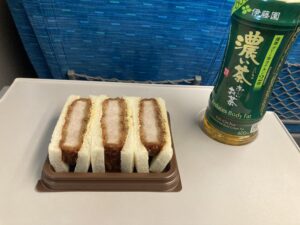
Slogan: “try as hard as a katsu sandwich.”
Three pillars characterise my approach:
- Long-duration video monitoring — 24-hour continuous recording to make visible the hours that no one has watched.
- Lab–field round trips — whatever I see in an aquarium, I try to verify in semi-natural and natural settings.
- Quantifying mating and ejaculate traits — sperm allocation, mating frequency, and courtship metrics measured as directly as I can manage.
If any of the keywords here resonate with your own system — behavior, reproduction, sexual selection, sperm competition, social structure, chemical communication — I would be very glad to hear from you. Collaborations, invited talks, and reviewing requests are all welcome.
Research highlights

Field survey of wild medaka
- Medaka start breeding at midnight, not at dawn. Continuous 24-hour video showed that, contrary to the textbook view, medaka begin courtship and spawning hours before sunrise — both in semi-outdoor enclosures and in the wild.
- Males keep mating even after sperm depletion. Males allocate sperm strategically with respect to female quality and rival presence, and continue to court and attempt to mate even after their sperm reserves are essentially exhausted.
- Field-based natural history of medaka. Long-term monitoring in semi-natural and outdoor settings is revealing the diel pattern of medaka reproduction and behavior in the wild.
Selected publications
First or corresponding author unless noted. For the full list, see ORCID or Google Scholar.
Temporal dynamics of courtship and spawning in medaka under laboratory conditions revealed by 24 h video monitoring
Yuki Kondo, Ryotaro Kobayashi, Yuya Kobayashi, Satoshi Awata
Scientific Reports, 15(1), 2025. Peer-reviewed.
[Article][Press (EN)]
Courtship and spawning behaviour of medaka in a semi-outdoor environment initiating at midnight
Yuki Kondo, Satoshi Awata
Scientific Reports, 15(1), 2025. Peer-reviewed.
[Article][Press (EN)]
Medaka (Oryzias latipes) initiate courtship and spawning late at night: Insights from field observations
Yuki Kondo, Kotori Okamoto, Yuto Kitamukai, Yasunori Koya, Satoshi Awata
PLOS ONE, 20(2): e0318358, 2025. Peer-reviewed.
[Article][Press (EN)]
Male medaka continue to mate with females despite sperm depletion
Yuki Kondo, Masanori Kohda, Satoshi Awata
Royal Society Open Science, 12(1), 2025. Peer-reviewed.
[Article][Press (EN)]
Sperm allocation in relation to male–male aggression and courtship in an externally fertilizing fish, the medaka
Yuki Kondo, Masanori Kohda, Yasunori Koya, Satoshi Awata
Animal Behaviour, 202, 9–19, 2023. Peer-reviewed.
[Article][Press (EN)]
Sperm allocation strategies depending on female quality in medaka (Oryzias latipes)
Yuki Kondo, Masanori Kohda, Yasunori Koya, Satoshi Awata
Zoological Science, 37(3), 203–203, 2020. Peer-reviewed.
[Article]
Awards
- Young Researcher Award, Kinki Chapter of the Ecological Society of Japan — “Are lab observations a faithful reproduction of field breeding times? A 3–4 hour gap revealed by 24-hour observation in medaka.” [Link]
- Outstanding Poster Award, 44th Annual Meeting of the Japan Ethological Society — “A 3–4 hour shift between lab and field environments: 24-hour observation reveals the breeding timing of medaka.” [Link]
- Best Poster Award, 69th Annual Meeting of the Ecological Society of Japan — “Strategies of both sexes over limited sperm in southern medaka.” [Link]
- Best Poster Award, 39th Annual Meeting of the Japan Ethological Society — “Surprisingly subtle: sneaking and sperm allocation strategies of male southern medaka.” [Link]
Funding (selected)
Grants-in-Aid for Scientific Research (KAKENHI, JSPS)
Grant-in-Aid for Early-Career Scientists (FY2025–2028, PI) — “Formation processes of complex social relationships in animals using medaka as a model.” [Link]
Grant-in-Aid for Scientific Research (C) (FY2024–2027, Co-I; PI: Yasunori Koya) — “Chemical communication between the sexes in medaka mating behavior.” [Link]
Grant-in-Aid for Scientific Research (B) (FY2022–2024, Co-I) — “Unraveling symbiotic and parasitic relationships in marine animals through cognitive evolutionary ecology.” [Link]
Grant-in-Aid for Research Activity Start-up (FY2022–2024, PI) — “Development of a novel ejaculate quantification method in fish and elucidation of male sperm allocation strategies under contrasting mating tactics.” [Link]
Other grants
- Kurita Water and Environment Foundation, Domestic Research Grant, “Emerging research (b)” (FY2024–2025, FY2025–2026)
- River Foundation, River Fund, General grant for early-career researchers (FY2025)
- Sasakawa Scientific Research Grant (FY2023, FY2024)
- Osaka Metropolitan University, Strategic Research Promotion Project, Early-Career Researcher Support (FY2023, FY2025)
- Tokyo Zoological Park Society, Wildlife Conservation Fund (FY2023, FY2024)
Outreach & teaching
Educational outreach
- Research class “What kinds of sensory organs do medaka have?” at Kawashima Junior High School, Kakamigahara City (FY2024, FY2025)
- Integrated learning class “Observing the wonders inside an egg” at Yonan Junior High School, Gifu City (FY2024, FY2025)
- Science cafe “Monkeys, me, and sometimes medaka” at the Yakushima Wildlife Survey Team (FY2022)
Media coverage (selected)
Nov 2025 — Medaka Trip, “Sequential mating experiment.” [Link (JP)]
Jul 2025 — National Geographic Japan, “Medaka: the truth about a too-familiar creature.” [Link (JP)]
May 2025 — Nikkei Science, “Anemonefish feeding their host anemone.” [Link (JP)]
Mar 2025 — Science Portal, “Medaka spawning starts from midnight.” [Link (JP)]
University teaching
- “Introduction to Biology” (one omnibus lecture), Osaka Metropolitan University (FY2022, FY2023)
- “Biology Laboratory,” Osaka Sangyo University (FY2018–FY2020)
Contact
For collaborations, invited talks, press inquiries, or visits to the lab, please write to youkikondou[at]omu.ac.jp or use the contact form. Brief inquiries via X/Twitter (@diary_of_yuki) are also welcome, though responses may be slower there.
Full publication / award / funding / outreach list → /publication/